
01↗
Units and discipline
How risk size is defined and why chasing losses is not part of the system.
EDUCATION / FOUNDATIONS
Education helps beginners use the service correctly and gives experienced customers a clearer way to assess price, variance and the long-term process.
Watch the video lessonsHow risk size is defined and why chasing losses is not part of the system.
How forecast, price and outcome differ, without presenting one signal as a guarantee.
Profit or loss, ROI or yield, voids, drawdown, losing streaks and the limits of historical results.
WATCH AND UNDERSTAND
Start with units and price, then explore delivery, review and reporting. Videos play only when you choose; each includes captions and a text version.
A unit is a personal measure, not a universal cash amount.
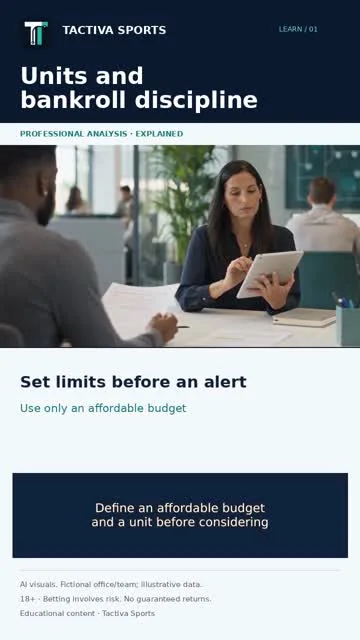
What does one unit mean? A unit is a consistent measure within your own betting plan, not a fixed amount everyone should stake. Here is a hypothetical example. If one unit is five euros, half a unit is two euros fifty, and two units are ten euros. Those figures explain the calculation. They are not a staking recommendation. Define an affordable budget and a unit before considering an alert. Never use borrowed money or money needed for everyday expenses. Keep your limits stable. Do not increase a unit to recover a loss. Units make stakes easier to compare, but they do not make a selection safer or guarantee profit. Record losses as carefully as wins. Tactiver sports. Understand the units, respect your limits, and remember that betting involves risk.
How the available price changes a hypothetical break-even threshold.
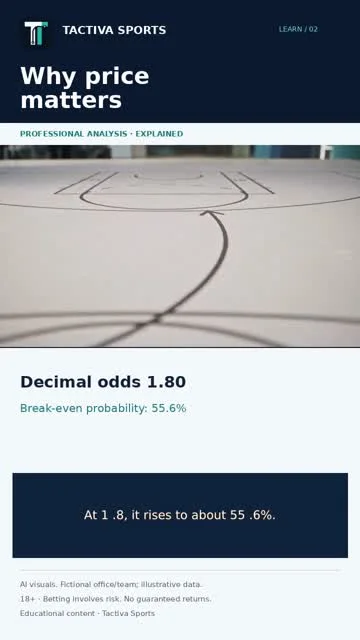
The same selection can be a different decision at a different price. Here is a hypothetical example. At decimal odds of 2.0, the breakeven probability is 50%. At 1.8, it rises to about 55.6%. Your assessment has not changed, but the price has. Respect the minimum acceptable odds. If the price moves below your threshold, pass. Tactiva Sports. Price Matters. No outcome is guaranteed.
How pre-game and live delivery differ in timing and validity.
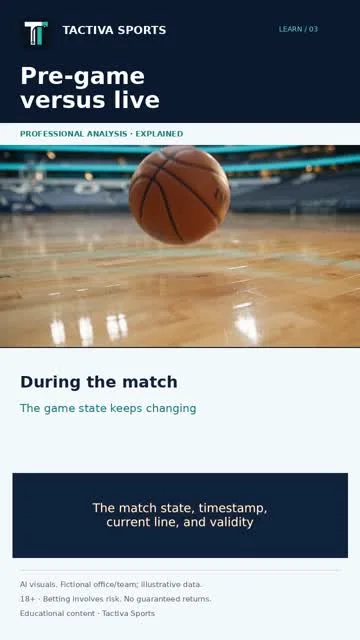
Pre-game and live analysis require different ways of working. Before the match, there is time to review team news, compare prices, and read the reasoning. Live markets move while the game is happening. The match state, timestamp, current line, and validity window become critical. A delayed alert may already be unusable. Never treat an expired price as an opportunity you can still take. Take Tactiva Sports. Understand the signal before acting. No outcome is guaranteed.
The information, price and review behind a selection.
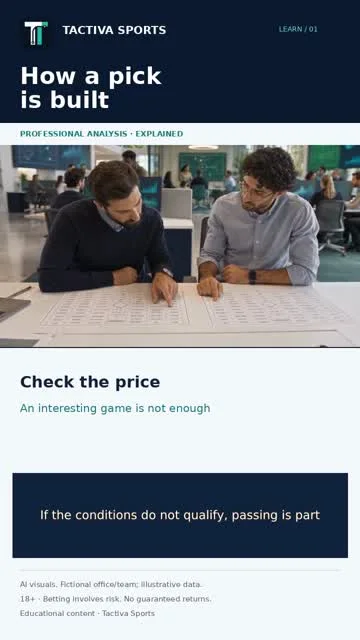
How does a pick become a pick? Start with the fixture, the schedule and the latest team news. Compare the evidence, assess the matchup and make uncertainty visible. Then check the price. If the conditions do not qualify, passing is part of the process. A clear selection explains the reasoning, the reference odds and when it is no longer valid. Tactiva Sports. Analysis for informed, disciplined decisions. No outcome is guaranteed.
Why an interesting game may not qualify for a selection.
Why does an opportunity get rejected? An interesting match is only the starting point. The information may be incomplete, the team news uncertain, or the available evidence too weak. Sometimes the analysis is useful, but the price does not meet the required threshold. Sometimes conditions change before an alert can be used. In each case, forcing a selection would hide the uncertainty. A disciplined process leaves room to pass. That also means there should be no forced daily quota of picks. For members, the same rule applies. If the available odds are below the stated minimum, or the alert has expired or been cancelled, skip it. More bets do not automatically mean better decisions. Tactiva sports. Understand the reasoning, respect the conditions, and remember that no outcome is guaranteed.
Read losses, units, sample size and reporting limits together.
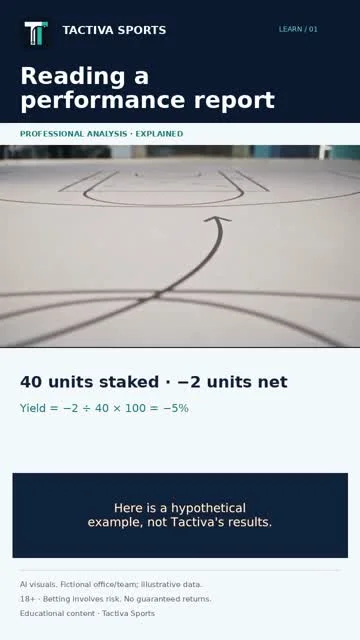
How do you read a performance report? Start with the reporting period and the number of settled selections. Check the unit's staked, wins, losses, voids, and any delivery exceptions. Net profit or loss measures what remained after stakes were accounted for. Yield compares that net result with the unit's staked, using the report's stated rules. Here is a hypothetical example, not Taktiva's results. 40 units staked and a net loss of two units gives a yield of minus 5%. Drawdown shows a fall from a previous peak in the cumulative result. A losing streak tells you how many selections lost consecutively. Read these alongside average odds, sample size, and the full record. A short winning period does not establish long-term performance. Taktiva sports. Read the complete picture. Past results do not guarantee future outcome.
18+. Educational material does not guarantee outcomes or recommend a bet on a particular event.
READ AND REFLECT
Read the lessons here. A verified account lets you save your progress across visits and devices.
The service is built around reviewed information, structured signals and clear reporting. It is not a promise of profit and it cannot remove the uncertainty of sports markets.
Read the next lessons before acting on a signal. They explain the vocabulary, the difference between PRE GAME and LIVE delivery, and the limits that protect a disciplined process.
An analysis explains how we view an event. An executable signal contains a selection, price, minimum price, unit size and validity. A correction changes or clarifies an earlier message. A cancellation or NO ACTION message means the original instruction should not be followed.
Always read the complete message and check the Signal ID. If the available price is below the stated minimum, the conditions are no longer the same and the correct decision is to pass.
Decide what one unit means for you before following any signal and keep that decision stable. Do not increase a unit to recover a loss, borrow money, or use money needed for everyday expenses.
A sound process can include losing runs, voids, price changes and periods without a qualifying opportunity. If participation becomes stressful or difficult to control, stop and seek appropriate support.
Check the Signal ID, event, competition, start time, market, selection, available odds, minimum odds, units, context, risk note and validity condition.
This is not a selection at any price. It applies only when the stated minimum price and validity conditions are still available. Read later corrections or cancellations before acting.
A LIVE signal identifies the Signal ID, match, minute or current state, market or line, current odds, minimum odds and units.
If the message arrives late, the market is suspended, the price is below the minimum or the state has changed, skip it. Do not recreate a signal from memory. If you cannot monitor the channel calmly, PRE GAME content may be a better fit.
Reports show wins, losses, voids, no-action records, units, net units, average odds, yield or ROI where the sample allows it, drawdown, losing streaks and operational notes.
A losing streak does not automatically prove that a process has failed, and a winning week does not guarantee the future. PRE GAME and LIVE are compared separately only when the sample is large enough to make the comparison useful.
After your first week, consider whether you can access the included channels, understand the formats, manage the message volume and follow your own limits.
This check-in is for service quality, not a sales pitch. Contact Support if you need help, want to pause communication, or have an access or delivery problem.